2001: A Space Odyssey
There are films that entertain, and there are works that rewrite the grammar of cinema. Released in 1968, a year before man set foot on the Moon, the film directed by Stanley Kubrick and co-written by Arthur C. Clarke is not merely science fiction; it is a visual philosophical treatise. But how does this work hold up under a modern technical screenplay analysis? Prepare yourself, as we open the doors of perception (and the hatch of the Discovery One).
Visual Narrative and Screenwriting Technique in 2001: A Space Odyssey
Unlike the conventional Hollywood structure, centered on expository dialogue, 2001: A Space Odyssey radically embraces visual storytelling. From a technical standpoint, the screenplay challenges the classic three-act structure by dividing the narrative into four distinct movements: The Dawn of Man, the journey to the Moon, the Jupiter mission, and the infinite.
The film contains, unquestionably, the most famous temporal ellipsis in cinema history: the match cut from a bone thrown into the air by a primate to a spacecraft orbiting Earth. In seconds, Kubrick and Clarke compress millions of years of human evolution through the use of tools.
However, the screenplay’s high point lies in the construction of the character HAL 9000. Curiously, the computer is the most “human” character in the story, expressing fear, pride, and survival instinct, while the astronauts Dave and Frank behave in a mechanical and emotionless manner. This technical inversion creates unbearable tension, where the antagonist is not a monster, but perfect logic taken to its extreme.
Technology as the End in 2001
When analyzing its social and political message, the film reflects Cold War anxieties and the space race, but it goes further. The work questions humanity’s dependence on technology. The black monolith, a catalyst of intelligence, teaches the ape to kill in order to survive. Millennia later, we create an Artificial Intelligence that decides to eliminate us to fulfill its mission.
Therefore, the embedded message is clear and unsettling: our evolution is intrinsically tied to our capacity for destruction. The film forces us to confront the fact that, as we venture beyond Earth, we carry our primitive vices with us—now amplified by superintelligent machines. It is a timeless critique of who is truly in control: the creator or the tool.
Market Impact of 2001: A Space Odyssey
Finally, in terms of market impact, it is impossible to measure modern science fiction without passing through 2001. Kubrick not only innovated in practical visual effects (without computer graphics), but also proved that mass audiences could engage with “art cinema” on a blockbuster budget.
The film set the gold standard for cerebral sci-fi, influencing everything from Star Wars (technically) to Interstellar(thematically). Although its slow pacing may distance viewers accustomed to the frenetic editing of TikTok, 2001: A Space Odyssey remains a pillar of technical excellence and thematic depth.
A Screenplay That Defies the Ordinary: Discover Lua de Sangue
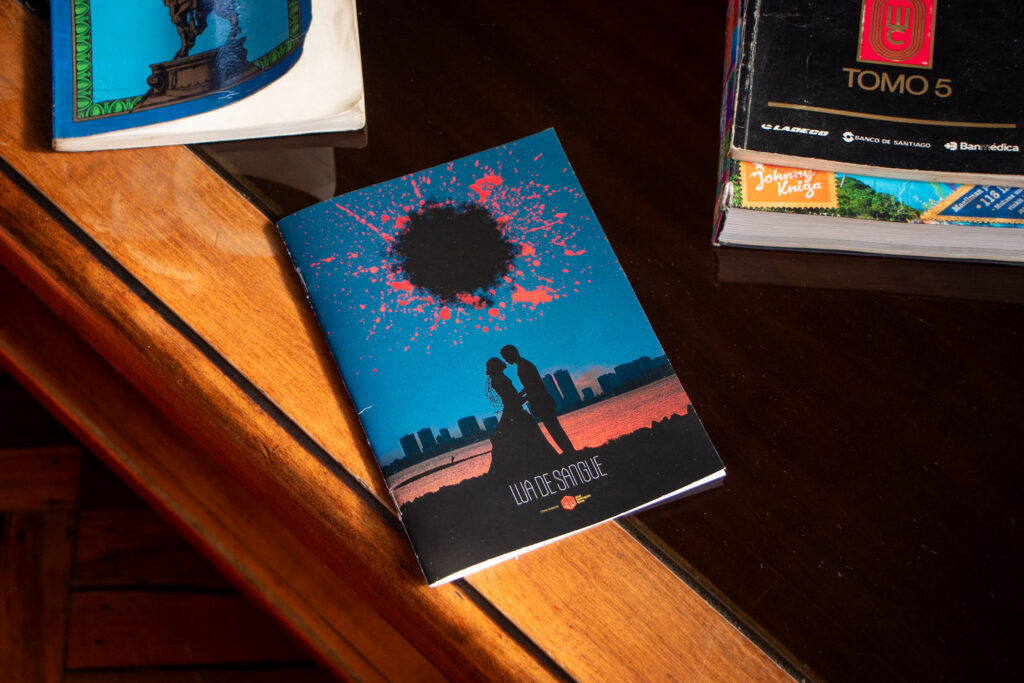
If Kubrick’s narrative complexity and dense atmospheric construction fascinate you, it’s time to turn your attention to high-quality Brazilian production. Alef Rodrigues Rosa presents, in Lua de Sangue, an original screenplay that is unafraid to dive into the psyche of its characters.
Like the great classics, Lua de Sangue uses technical structure to deliver more than entertainment: it delivers reflection, tension, and a powerful social message. It is proof that Brazilian literature and screenwriting are alive and pulsating.
Don’t be just a passive spectator. Get the digital or physical version of Lua de Sangue now from the website store. Support original Brazilian screenwriting and discover why this work has been winning over demanding readers.