The year was 1999. While the world feared the “Millennium Bug,” the Wachowski sisters delivered a far more complex and fascinating glitch into the Hollywood system. The Matrix didn’t arrive merely as an action film with guns and leather coats; it landed as a philosophical manifesto wrapped in cyberpunk aesthetics. But why do we still “take the red pill” more than two decades later? The answer lies in the invisible architecture of its screenplay.
The Hero’s Journey and Technical Language in The Matrix
From the perspective of technical language, The Matrix is perhaps the most didactic and perfect application of Joseph Campbell’s Hero’s Journey in modern cinema. The screenplay rigorously follows the steps of the monomyth, yet does so with an innovative technological layer.
The “Ordinary World” of Thomas Anderson is gray and oppressive, in stark contrast to the “Special World” of the desert of the real. The inciting incident—the message “Follow the white rabbit”—is a masterful example of narrative economy. Moreover, the screenplay uses exposition (the moment when Morpheus explains the Matrix) visually, within the Construct, transforming what could have been a dull monologue into one of the most iconic scenes in film history.
Technically, the introduction of the Bullet Time effect was not merely aesthetic; it functioned as a narrative tool to show that Neo was beginning to see “between the frames” of reality, manipulating time and space—visually reinforcing his evolution as “The One.”
The System and Identity
When analyzed through its social and political message, the film reveals itself as a sharp critique of corporate capitalism and conformity. Agent Smith is not just a villain; he represents the maintenance of the status quo, the force that suppresses any anomaly threatening the established order.
In this sense, the narrative addresses the alienation of the modern worker (symbolized by Neo’s cubicle) and the illusion of choice. Additionally, the film has been interpreted as a powerful allegory for gender transition and the search for true identity, considering the lived experiences of the directors. The “red pill” represents a painful but necessary awakening to truth—a metaphor that has, unfortunately, been appropriated by various political groups, but which, in the screenplay’s essence, calls for individual freedom against systems of mass control.
Market Impact of The Matrix
Finally, in terms of market impact, The Matrix redefined the action genre. Before it, the standard was the brute-force heroes of the 1980s. After it, the market demanded complex fight choreography (influenced by Hong Kong’s wire-fu), pop philosophy, and the full integration of CGI with practical filmmaking.
The film proved that mass audiences not only accept but desire blockbusters that challenge the intellect. In short, The Matrix is a masterpiece of pacing, concept, and execution that transformed digital cinema into art.
Awaken to a New Reality: Read Lua de Sangue
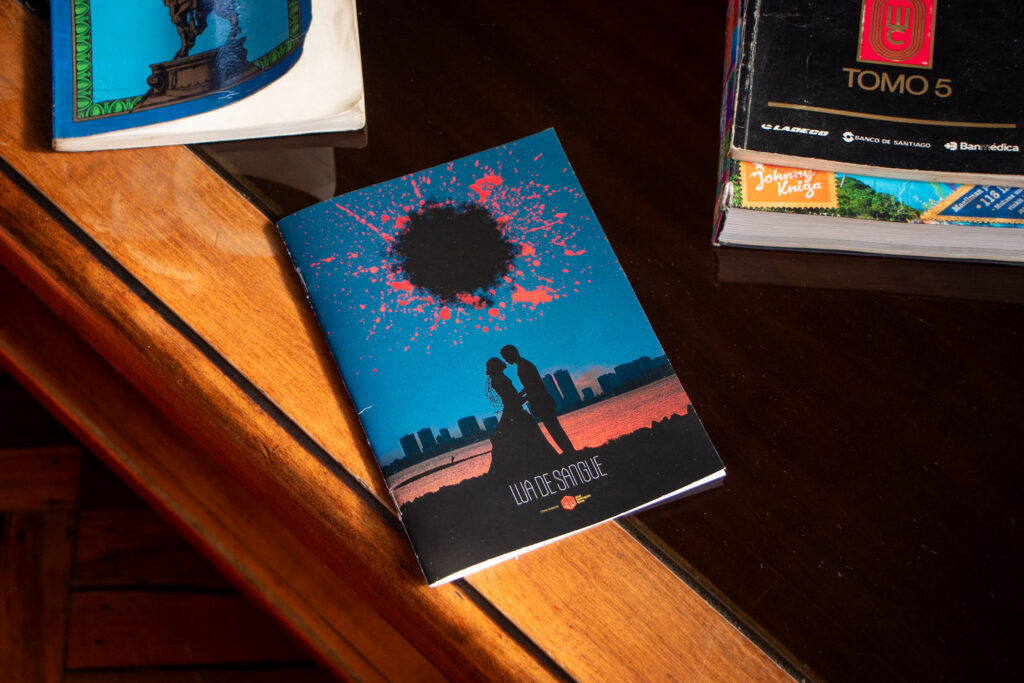
If the struggle against oppressive systems and the discovery of hidden truths in The Matrix resonate with you, the screenplay of Lua de Sangue will be your next obsession.
Alef Rodrigues Rosa weaves a narrative in which reality is far darker than it appears. With impeccable technical construction and twists that challenge the reader’s perception, this Brazilian authorial work delivers the suspense and action that fans of strong fiction seek.
Do not take the blue pill of literary sameness.
Choose the truth. Purchase your digital or physical copy of Lua de Sangue in the site’s store and support independent national production that dares to challenge the ordinary.