At this very moment, the Brazilian influencer Bruno Aiub is once again driving transformations in the content creator market. Regardless of opinions about his public persona, his impact on the industry deserves to be examined.
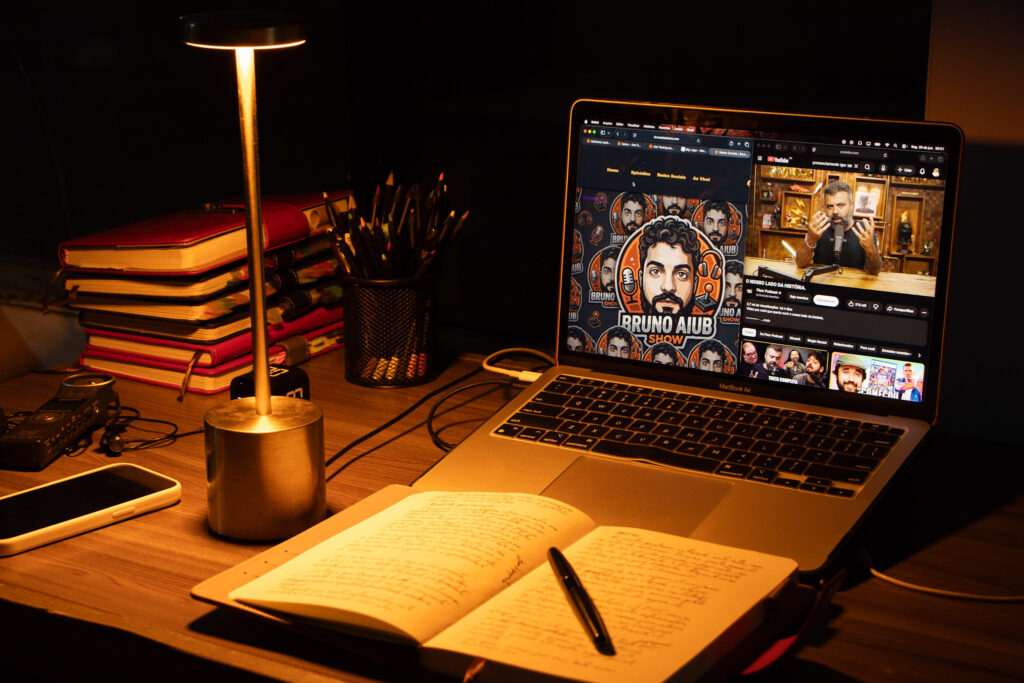
During the week I am producing this article, the Brazilian internet is witnessing—amid the World Cup and thousands of other controversies—a public falling-out between Bruno Aiub, also known as Monark, who was canceled after a controversial and unfortunate statement on his show, and Igor Coelho, known as Igor 3K.
Both were partners and hosts of the Flow Podcast, which at the time became one of Brazil’s most influential online programs. They were responsible for popularizing the Joe Rogan Experience model in Brazil. In an attempt to defend a conception of free speech similar to that of the United States, Bruno argued that the Brazilian state should allow, among other things, the creation of a Nazi party.
Following that statement, media pressure intensified. Guests who had previously collaborated with Flow requested that their episodes be removed. Sponsors terminated their contracts, and even YouTube suspended the channel’s monetization. The entire financial structure of Flow Studios was shaken, putting the continuity of its programs into question.
From generating millions in revenue to virtually nothing, the company suddenly had to sustain a large and costly operation with dozens of employees. The partnership between the two founders, already strained by similar incidents, did not survive. An agreement was reached: Igor would buy Bruno’s stake and continue leading the project.
Both followed their own paths.
Unable to distribute his content through the internet’s most established channels, Bruno migrated to emerging platforms, only to face new controversies and restrictions related to his statements about the security of electronic voting machines. He later moved to the United States, where he remained for several years.
Igor took on the difficult task of rebuilding Flow Studios, a brand that had become associated in the public imagination with one of the most condemned ideologies in contemporary history. It was an ungrateful undertaking.
Persona Non Grata
And here we arrive at the part that interests us on this blog.
After returning from the United States, Bruno expressed his intention to relaunch his interview program online. However, he discovered that the commercial consequences of his cancellation remained. Several platforms no longer accepted him as a business partner, creating a form of long-term digital exile.
What do you do when no distributor wants your content?
Audience Preference
There is an extremely important point that every audiovisual producer must understand: distributors have audience preferences.
The age of algorithms is often criticized, but this phenomenon has always been part of the nature of audiovisual media. Every exhibition network—traditional or digital, commercial or ideological—has a specific target audience that it must serve in order to sustain its business model.
This directly affects content curation. Same principle applies to Sundance, the Gramado Film Festival, Movie Theaters, Broadcast networks, Netflix, Prime Video, YouTube, Instagram, or TikTok. The difference is that while traditional media delegated this function to executives, digital platforms transferred it to algorithms. The fuel, however, remains the same: the audience.
I experienced this firsthand when I finished Rose, my first short film. I initially released it on YouTube, but after some time I realized that the platform was unlikely to reward cinematic productions consisting of self-contained stories within a single video. Its preference lies with serialized and recurring content. And that was not the path I sought as an audiovisual filmmaker at that moment.
Revenue Models
These reflections led me to conclude that there are two major categories for generating revenue in audiovisual media: marketing or ticket sales.
In the marketing-based model, content serves as a promotional instrument for third-party products, services, or ideas. The expectation is that the audience will consume whatever is being advertised.
In the ticket-sales model, the content itself is the product being sold. People pay to access an audiovisual experience, whether for entertainment, education, or information.
Much of the popular internet operates predominantly under the first model.
It is possible to combine both, but one almost always prevails over the other.
When Bruno Aiub’s cancellation occurred, Flow had already significantly reduced its dependence on the ticket-sales model—represented by recurring supporters—and embraced advertising more intensely, becoming increasingly dependent on brand sponsors.
Every Piece of Content Has Its Audience
The choice of business model and distribution partner is decisive in determining the editorial and financial freedom of any audiovisual producer.
Each model has its advantages and limitations.
The main disadvantage of the ticket-sales model is the need to control virtually the entire chain, from creation to exhibition. The principal limitation of the marketing model is commercial acceptance. Depending on the content produced, certain brands simply will not want to associate their image with it.
I recall interviews in which Felipe Castanhari spoke about the difficulties of monetizing documentaries about the Second World War due to the presence of violent themes.
For that reason, there will always be situations in which a particular audience is of no interest to any existing commercial or institutional distributor.
Customized OTT Platforms
In such cases, the solution may be to assume greater control over the distribution chain.
Traditional exhibition methods required heavy transmission structures and physical infrastructure. With the popularization of the internet, it became possible to bypass these intermediaries. The Over-The-Top (OTT) concept emerged, encompassing the direct distribution of content through the network—videos, music, texts, and images—whether free, as on YouTube, or subscription-based, as on Netflix.
Developing a proprietary platform requires technical teams, server infrastructure, and robust payment systems—something difficult, though not impossible, for independent creators.
Fortunately, many companies now offer this infrastructure as a service. This allows producers to focus their efforts on content creation while maintaining greater editorial freedom and a direct relationship with their audience.
OTT platforms represent an excellent alternative for teachers, researchers, and specialists who wish to distribute knowledge and monetize their work without relying on intermediaries.
This model also proved to be a perfect fit for the BIGLAGO project and, in my view, constitutes one of the most promising paths for truly independent filmmakers.
And it is precisely here that Bruno Aiub may once again influence the Brazilian audiovisual market: by popularizing a consumption model based on the direct relationship between creator and audience.
In education, this habit is already well established. In entertainment, however, we may be witnessing one of the first instances in which a high-profile personality chooses to embrace this path on a large scale.